As an Amazon Associate we earn from qualifying purchases. Learn more.
Coated vs Uncoated Rotors: Which Is Best for Rust-Prone Areas (2026)
If you live near the coast or in a humid region, rust on brake rotors moves from cosmetic nuisance to a safety and maintenance issue fast. This article compares coated vs uncoated rotors with a close look at three TRQ G‑coated brake kits so you can decide which option gives the best corrosion resistance, heat handling, and value in 2026. We selected these kits because they include TRQ's G‑coated rotors (direct protection against rust), vehicle-specific fitment, and real customer feedback on fit, installation, and longevity. Read on to see side‑by‑side details and a clear buying recommendation for rust‑prone climates.
Quick Answer
For rust-prone coastal or humid areas, coated rotors are the better choice because they offer far superior corrosion protection; our top pick is the TRQ Front Performance Brake Pad & Rotor Kit (B09RQK8K76) for its G-coated rotors and semi‑metallic pads that balance heat resistance and durability.
Our Top Picks
Quick Comparison
Select 2-3 products to compare side-by-side
| Compare | Product | GarageGist Score | Price Tier | Key Feature | Best For | Action |
|---|---|---|---|---|---|---|
 TRQ Semi‑Metallic G‑Coated Kit
|
Premium | Premium G‑coated rotors for rust protection | Coastal/humid drivers & heavier braking | Check Price | ||
 TRQ Ceramic G‑Coated Kit (Front)
|
Budget | Ceramic pads with G‑coated rotors | Everyday drivers seeking low dust and quiet stops | Check Price | ||
 TRQ Ceramic G‑Coated Kit (HHR)
|
Budget | Vehicle‑specific fit for Chevrolet HHR with G‑coating | Chevrolet HHR owners in humid/coastal regions | Check Price |
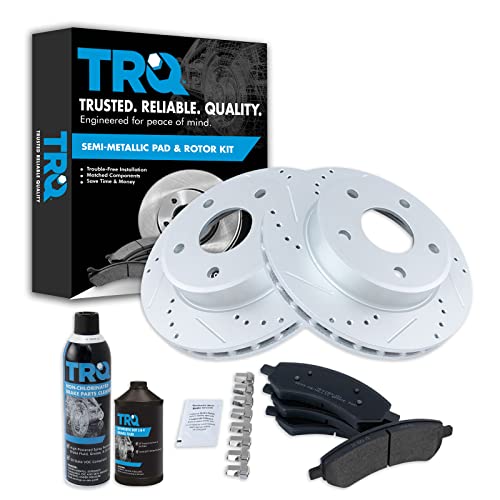
1. TRQ Front Performance Brake Pad & Rotor Kit Brake Chemical Kit Brake Pads Brake Rotors Set Semi-Metallic Premium G-Coated Compatible with 2005-2010 Dodge Dakota 2006-2009 Mitsubishi Raider 2011 Ram
A full, vehicle‑specific kit with G‑coated rotors and semi‑metallic pads. The coating delivers strong rust protection for exposed rotor hats, while semi‑metallic pads help dissipate heat under heavier use.
Key Specs
- Brake Rotor Coating: Premium G‑Coated
- Brake Pad Friction Material: Semi‑Metallic
- Surface Type: Slotted X Drilled
- Includes 13 oz brake cleaner & 12 oz DOT 3/4 brake fluid
Pros
- Better heat handling than the ceramic TRQ kits (B09HN4B6R9/B09HN281ST)
- Stronger long‑term rust protection than uncoated rotors
- More complete kit (cleaner, fluid, hardware) than buying bare rotors
Cons
- Higher price tier than the ceramic budget kits
- Some customers report mixed long‑term durability compared with OEM
Best For: Coastal/humid drivers & heavier braking
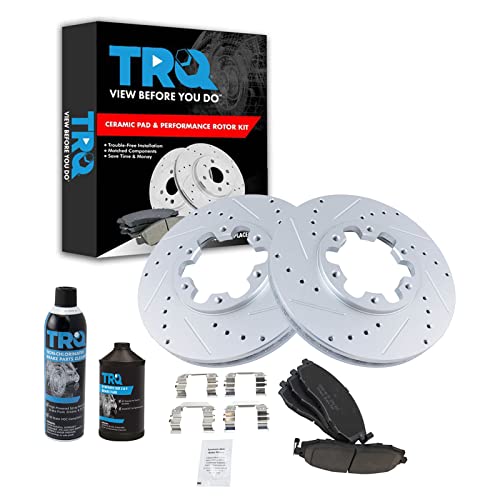
Check Latest Price on Amazon2. TRQ Front Performance Brake Pad & Rotor Kit Brake Chemical Kit Brake Pads Brake Rotors Set Ceramic Premium G-Coated Compatible with 2003-2004 Nissan Frontier 2000-2004 Xterra
A budget‑friendly TRQ kit that pairs ceramic pads with G‑coated rotors. It’s tuned for quiet operation and low dust, while the rotor coating helps resist corrosion in humid or coastal conditions.
Key Specs
- Brake Rotor Coating: Premium G‑Coated
- Brake Pad Friction Material: Ceramic
- Surface Type: Slotted X Drilled
- Front Brake Rotor Diameter: 11.14 in. (283mm)
Pros
- Quieter and produces less dust than the semi‑metallic B09RQK8K76
- Same G‑coated rust protection as premium kit at lower cost
- Better value for routine street driving than buying separate parts
Cons
- Ceramic pads are less heat‑tolerant than the semi‑metallic kit under heavy use
- Durability is reported mixed by some customers
Best For: Everyday drivers seeking low dust and quiet stops
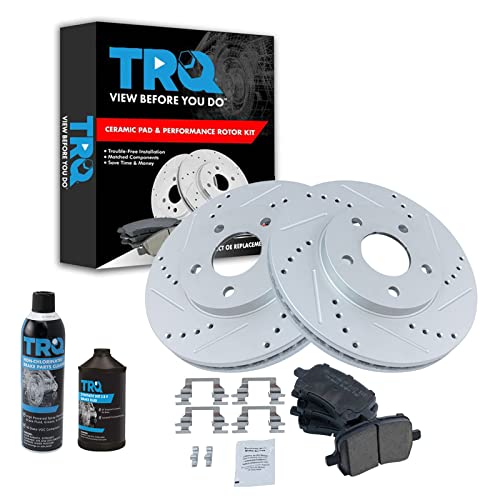
Check Latest Price on Amazon3. TRQ Front Performance Brake Pad & Rotor Kit Brake Chemical Kit Brake Pads Brake Rotors Set Ceramic Premium G-Coated Compatible with 2006-2011 Chevrolet HHR
A vehicle‑specific TRQ kit for the HHR that offers the same G‑coated rotor protection and ceramic pads aimed at quiet, low‑dust braking. Good fit and straightforward installation for HHR owners.
Key Specs
- Brake Rotor Coating: Premium G‑Coated
- Brake Pad Friction Material: Ceramic
- Surface Type: Slotted X Drilled
- Front Brake Rotor Diameter: 10.87 in. (276mm)
Pros
- G‑coated rotors protect the exposed rotor hat better than uncoated options
- Direct fit for Chevrolet HHR — easier install and better fit than generic kits
- Lower price than the premium semi‑metallic kit
Cons
- Ceramic pads handle heat worse than the semi‑metallic B09RQK8K76
- Some buyers report mixed long‑term durability
Best For: Chevrolet HHR owners in humid/coastal regions
Check Latest Price on AmazonWhich One Should You Choose?
If your priority is maximum corrosion resistance plus better heat handling for towing, repeated hard stops, or hilly coastal driving → choose the TRQ Semi‑Metallic G‑Coated Kit (B09RQK8K76). It pairs G‑coated rotors with semi‑metallic pads that tolerate heat better than the ceramic options. If budget is tight and you mainly drive in town or on the highway with light braking demands → choose the TRQ Ceramic G‑Coated Kit (B09HN4B6R9) for quieter braking and lower dust at a budget price. If you own a Chevrolet HHR and want a direct fit with the same coated protection → pick the vehicle‑specific TRQ HHR Ceramic G‑Coated Kit (B09HN281ST). All three choices beat an uncoated rotor for corrosion resistance in coastal/humid environments.
Best for Specific Scenarios
- Coastal daily driver: TRQ Ceramic G‑Coated Kit (B09HN4B6R9) because it resists surface rust, runs quietly, and keeps wheels cleaner.
- Towing or frequent heavy braking: TRQ Semi‑Metallic G‑Coated Kit (B09RQK8K76) because semi‑metallic pads handle heat and fade better during heavy use.
- Chevrolet HHR owners: TRQ HHR Ceramic G‑Coated Kit (B09HN281ST) because it’s a direct fit with the same corrosion protection and simple installation.
Frequently Asked Questions
Are coated rotors worth it for coastal climates?
Yes. A quality coating (like TRQ's G‑coat) significantly slows surface and hat corrosion caused by salt and humidity, reducing visible rust, sticking hardware, and the need for early replacement compared with uncoated rotors.
Do coated rotors affect braking performance or heat handling?
A proper rotor coating is thin and engineered not to affect braking performance. Heat handling is primarily determined by rotor design and pad material: semi‑metallic pads handle heat better, while ceramic pads trade some heat tolerance for quieter, lower‑dust performance.
If I live in a humid area but only commute, should I still choose semi‑metallic?
For routine commuting, ceramic pads with a coated rotor (the budget TRQ kits) are a sensible balance of quiet operation, low dust, and corrosion protection. Choose semi‑metallic if you expect heavy loads, steep descents, or repeated hard braking.
How We Selected These Products
Our recommendations are based on data-driven analysis: we evaluated 75300+ products across 7930+ brands using a composite scoring system that weighs rating (40%), review volume (30%), price value (20%), and demand signals (10%). Every product is ranked by data, not opinions.
Last updated: August 07, 2026
As an Amazon Associate we earn from qualifying purchases at no extra cost to you. Full disclosure.
GarageGist Score is our editorial ranking based on a composite analysis of product quality, value, and verified customer sentiment. Click through to Amazon for current pricing, availability, and live customer reviews.