As an Amazon Associate we earn from qualifying purchases. Learn more.
Coated vs Stainless vs Uncoated Rotors: Corrosion Tradeoffs (2026)
If you care about rust, heat tolerance and overall value when replacing rotors, this head-to-head comparison breaks down the tradeoffs between coated, e-coated (black), and plain rotor options. You’ll learn how each type handles corrosion, where heat-related brake fade shows up, and which kits give the best long-term value. We tested selections based on material/coating, rotor design (slotted/drilled/vented), pad pairing, customer feedback on fit and durability, and cost tier to recommend the right rotor kit for common driving conditions.
Quick Answer
Coated rotors give the best balance of corrosion resistance and cost — the TRQ Front Performance Brake Pad & Rotor Kit (B0B9YPBVH9) is our top pick for overall value and rust protection. For tight budgets, the Max Advanced Brakes kit (B00IIWHXMA) offers strong heat-management features at a lower price.
Our Top Picks
Quick Comparison
Select 2-3 products to compare side-by-side
| Compare | Product | GarageGist Score | Price Tier | Key Feature | Best For | Action |
|---|---|---|---|---|---|---|
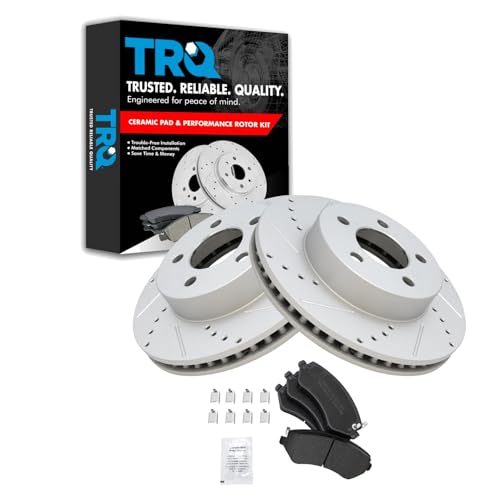 TRQ G-Coated Jeep Kit
|
Mid-Range | Premium G-coated rotor finish | Drivers wanting rust protection and OE fit | Check Price | ||
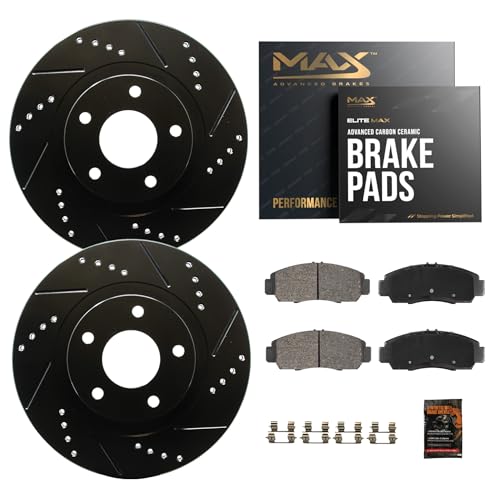 Max Black E-Coat Kit
|
Budget | Black e-coating + ceramic pads | Budget buyers who tow or haul | Check Price | ||
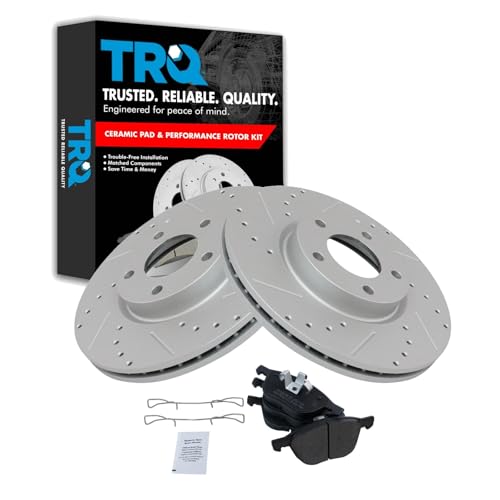 TRQ G-Coated Mazda Kit
|
Premium | Electrostatic G-coating, OE fitment | Drivers who prioritize longevity and OEM fit | Check Price |
1. TRQ Front Performance Brake Pad & Rotor Kit Semi-Metallic Premium G-Coated Compatible with 2002-2007 Jeep Liberty
A well-rounded OEM-style kit with electrostatic G-coating for long-lasting rust resistance, slotted and drilled rotors for heat control, and semi-metallic pads. Customers praise fit and quiet operation; pad durability reports are mixed. Overall it balances corrosion protection and performance for daily drivers.
Key Specs
- Surface: Slotted & Drilled (X pattern)
- Rotor Coating: Premium G-Coated (electrostatic)
- Rotor Diameter: 11.34 in / 288 mm
- Vent Type: Vented
Pros
- Stronger corrosion protection than uncoated rotors
- Better fit and quieter operation than some budget kits
- Balanced heat control (slotted/drilled) compared with plain rotors
Cons
- Pad durability has mixed reports from owners
- Mid-range cost higher than budget e-coated kits
Best For: Drivers wanting rust protection and OE fit
Check Latest Price on Amazon2. Max Advanced Brakes Rear Brake Kit Compatible With 2011-2018 2019 Ford Edge Explorer Flex Taurus w/12.99" Rear Rotor Replacement Drilled Slotted Black Coated Disc Brake Rotors and Ceramic Brake Pads
Budget-oriented drilled/slotted rotors with a black e-coating and paired ceramic pads designed for heavy loads and towing. Offers excellent initial stopping and heat dissipation; many users report good value and straightforward installation, though rust resistance performance is mixed in some climates.
Key Specs
- Surface: Drilled & Slotted
- Rotor Coating: Black e-coating
- Rotor Diameter: 12.99 in (rear fitments listed)
- Pad Type: Thermal-stable ceramic, includes hardware
Pros
- Better high-heat performance for towing than plain rotors
- Stronger value for money than premium kits
- Includes hardware for easier installation compared with some aftermarket sets
Cons
- Rust resistance can be inconsistent in aggressive climates
- Drilled/slotted design can accelerate pad wear compared with solid rotors
Best For: Budget buyers who tow or haul
Check Latest Price on Amazon3. TRQ Front Performance Brake Pad & Rotor Kit Semi-Metallic Premium G-Coated Compatible with 2004-2013 Mazda 3 2006-2015 5
Premium option in the TRQ line with a durable G-coated finish, application-specific design and semi-metallic pads. Praised for fit, quiet operation and braking feel; positioned as a higher-tier choice for drivers who want longer rust protection and precise fit.
Key Specs
- Surface: Slotted & Drilled (X pattern)
- Rotor Coating: Premium G-Coated
- Rotor Diameter: 11.81 in / 300 mm
- Vent Type: Vented; OE replacement kit
Pros
- Better long-term rust resistance than basic e-coated rotors
- Tighter, application-specific fit than generic kits
- Quieter stopping performance compared with many drilled-only options
Cons
- Higher price tier than budget kits
- Pad durability has mixed customer feedback
Best For: Drivers who prioritize longevity and OEM fit
Check Latest Price on AmazonWhich One Should You Choose?
If corrosion protection and a solid OE-like fit are your priority: pick the TRQ Front Performance Brake Pad & Rotor Kit for Jeep (B0B9YPBVH9). It combines a durable electrostatic G-coating with vented, slotted/drilled rotors for balanced heat control and long-term appearance.
If budget is tight but you need better heat handling for towing or heavy use: choose the Max Advanced Brakes Rear Kit (B00IIWHXMA). Its black e-coating and ceramic pads give strong stopping power and cooling at a lower price point.
If you want the highest-tier fit and longest-lasting coating in this group and you're willing to pay more: the TRQ Front Performance Brake Pad & Rotor Kit for Mazda (B0B7GL7M33) is the premium option—best for drivers who keep cars long-term or drive in corrosive environments.
Best for Specific Scenarios
- Daily driver in a salty coastal area: TRQ G-Coated Kits (B0B9YPBVH9 or B0B7GL7M33) because the electrostatic coating protects the rotor hat and face longer than basic e-coats.
- Towing, hauling, or mountain driving: Max Advanced Brakes (B00IIWHXMA) because drilled/slotted rotors and ceramic pads handle repeated heavy braking and heat better on a budget.
- Budget-focused maintenance and straightforward swaps: Max Advanced Brakes (B00IIWHXMA) because it includes hardware and is designed for easy installation with good value for money.
Frequently Asked Questions
Are coated rotors worth the extra cost?
Yes for most drivers. Coated rotors (G-coat or e-coat) significantly reduce rust on the hat and outer face, extending cosmetic life and often service life in corrosive climates. If you plan to keep a car several years or live near salt, the coating pays back in fewer replacements and cleaner wheels.
Do drilled and slotted rotors cause more pad wear?
They can. Slotted/drilled surfaces help heat and gas evacuation which improves high-load performance but often produce slightly higher pad wear than plain rotors. Choose ceramic pads with drilled/slotted rotors to balance wear and noise, or plain rotors if you want maximum pad life.
Can I mix coated and uncoated rotors on the same axle?
You can, but it’s not ideal. Mixing types may lead to uneven corrosion appearance and minor differences in heat behavior. For consistent braking performance and wear, replace both rotors on the same axle with matching type and finish.
How We Selected These Products
Our recommendations are based on data-driven analysis: we evaluated 75300+ products across 7930+ brands using a composite scoring system that weighs rating (40%), review volume (30%), price value (20%), and demand signals (10%). Every product is ranked by data, not opinions.
Last updated: July 25, 2026
As an Amazon Associate we earn from qualifying purchases at no extra cost to you. Full disclosure.
GarageGist Score is our editorial ranking based on a composite analysis of product quality, value, and verified customer sentiment. Click through to Amazon for current pricing, availability, and live customer reviews.