As an Amazon Associate we earn from qualifying purchases. Learn more.
Jumper Cables vs Welding-Clamp Jump Kits vs Portable Jump Starters: Which to Keep in Your Garage (2026)
If you keep a vehicle in a cold climate or want true roadside reliability, choosing between traditional jumper cables, welding‑clamp style leads, and battery-powered portable jump starters matters. This guide compares three popular jumper cable kits available in 2026, weighing reliability, garage space, and winter/fall readiness. Products were selected for strong customer praise around build quality, conductivity and value, and to represent budget, mid-range and premium approaches. Read on to see head‑to‑head pros and cons and which kit suits your garage needs.
Quick Answer
For most garages a heavy-duty premium jumper cable kit is the best all-around choice — the Nilight 0 Gauge 30 FT kit tops the list for reliability and cold-weather performance. If you need a budget, compact backup choose the All Road 2‑gauge 20 ft set; for UL-listed build quality and warranty pick the TOPDC 1‑gauge 25 ft kit.
Our Top Picks
Quick Comparison
Select 2-3 products to compare side-by-side
| Compare | Product | GarageGist Score | Price Tier | Key Feature | Best For | Action |
|---|---|---|---|---|---|---|
 All Road 2GA 20ft |
Budget | Compact 20 ft kit with carry bag | Drivers on a budget; smaller cars | Check Price | ||
 Nilight 0GA 30ft |
Premium | 0 gauge, 30 ft heavy‑duty cables | Large vehicles, trucks, cold climates | Check Price | ||
 TOPDC 1GA 25ft |
Mid-Range | UL‑listed with 5‑year assurance | Drivers wanting verified safety and warranty | Check Price |
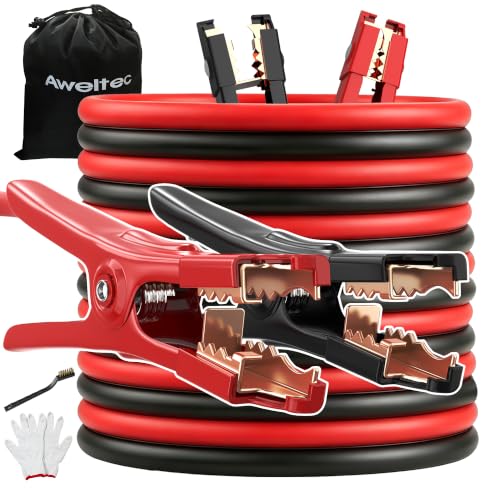
1. UL-Listed Jumper Cables - 2 Gauge 20 Feet Battery Jumper Cables for Car, Heavy Duty Booster Cables (2AWG x 20Ft) with Carry Bag, Safety Gloves and Iron Brush
A wallet-friendly, UL‑listed 2‑gauge kit that balances conductivity with portability. Customers praise its build quality and included storage bag, making it an easy garage staple for everyday drivers who want dependable backup without a large investment.
Key Specs
- Gauge: 2 AWG, 20 feet
- Conductor: copper‑clad aluminum (CCA)
- Temperature range: -40°F to 140°F
- Includes carry bag, gloves and iron brush
Pros
- Great value and lighter than thicker gauge kits
- Better compact storage than bulkier cables
- UL‑listed design and all‑purpose clamps
Cons
- Mixed reports on long‑term durability under heavy use
- Less current capacity than 1/0/0 gauge alternatives
Best For: Drivers on a budget; smaller cars
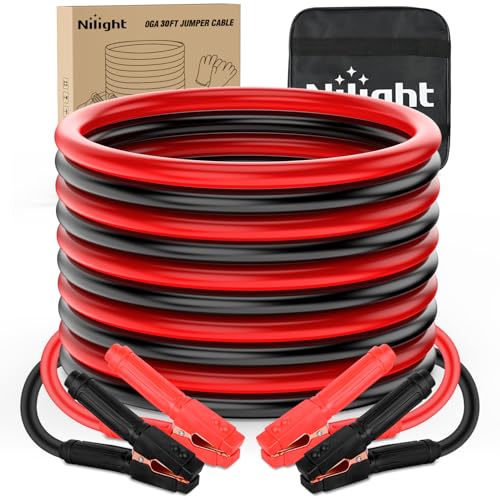
Check Latest Price on Amazon2. Nilight Jumper Cables for Car Battery 0 Gauge 30 FT Booster Cable Heavy Duty 1000 A CCA with Carrying Bag Jump Start Emergency Kit Pickup Truck RV Vans SUV
A heavy‑duty 0‑gauge, long‑reach kit designed for trucks, RVs and high‑demand jump situations. It stands out for superior conductivity and extreme‑temperature flexibility, making it the most reliable option for cold weather and repeated use.
Key Specs
- Gauge: 0 AWG, 30 feet
- Instantaneous current capacity: up to 1000 A
- Conductor: copper‑coated aluminum (CCA)
- Insulation: premium PVC, low temp flexible (-40°C)
Pros
- Higher current capacity for big engines and quick starts
- PVC insulation stays flexible in very cold weather
- Long 30 ft reach helps with awkward battery access
Cons
- Heavier and bulkier to store than thinner kits
- Some customers note separate wire assemblies instead of molded one‑piece construction
Best For: Large vehicles, trucks, cold climates
Check Latest Price on Amazon3. TOPDC 1 Gauge 25 Feet Jumper Cables for Car, SUV and Trucks Battery, Heavy Duty Automotive Booster Cables for Jump Starting Dead or Weak Batteries with Carry Bag, (TD-P0125)
A balanced 1‑gauge option with UL certification and a manufacturer quality assurance. Customers consistently praise clamp grip and cable length, and the 5‑year promise makes it appealing for buyers prioritizing documented quality and rust‑resistant insulation.
Key Specs
- Gauge: 1 AWG, 25 feet
- UL‑listed; operational -40°F to 140°F
- Insulating rubber‑covered clamps
- 5‑year quality assurance from manufacturer
Pros
- Strong clamps and secure grip on battery posts
- Long reach and robust insulation for seasonal use
- Backed by a multi‑year quality assurance
Cons
- Mid‑weight — not as light as budget options
- Some buyers debate long‑term rust resistance
Best For: Drivers wanting verified safety and warranty
Check Latest Price on AmazonWhich One Should You Choose?
If budget is tight → Choose the All Road 2 Gauge 20 Ft kit (B08MKNJ9FK). It delivers reliable performance for daily drivers, stores compactly, and includes useful extras like gloves and a brush. If you need the most reliable heavy‑duty option for trucks, RVs or cold climates → Choose the Nilight 0 Gauge 30 Ft kit (B0DHXMFZ5T). Its higher current capacity and low‑temp insulation make it the best overall for demanding use. If verified safety, UL certification and a long manufacturer assurance are priorities → Choose the TOPDC 1 Gauge 25 Ft kit (B073VHMYGR). It’s a balanced mid‑range option with strong clamps and a multi‑year quality promise.
Best for Specific Scenarios
- Cold winter roadside emergencies: Nilight 0GA 30 FT (B0DHXMFZ5T) because the thicker gauge and low‑temp PVC stay flexible and deliver more current to a tired battery.
- Compact city car or tidy garage: All Road 2GA 20 FT (B08MKNJ9FK) because it stores small, is lightweight and gives good value for occasional use.
- Peace of mind with certified parts: TOPDC 1GA 25 FT (B073VHMYGR) because UL listing, robust clamps and a warranty make maintenance and seasonal readiness simpler.
Frequently Asked Questions
How important is gauge when choosing jumper cables?
Gauge is critical. Lower gauge numbers (0, 1) mean thicker wire and higher current capacity — better for large engines, diesel trucks or frequent jumps. 2 AWG is fine for everyday passenger cars and occasional use but will be less effective on heavy vehicles or in severe cold.
Can I store jumper cables in the garage during winter?
Yes. Keep them in a dry carry bag and off concrete floors where moisture can corrode clamps. Choose cables with low‑temperature rated insulation if you expect subfreezing use; PVC or specially formulated sheaths resist cracking in cold weather.
Are portable jump starters better than jumper cables?
Portable jump starters remove the need for a donor vehicle and are extremely convenient, but they add cost and require charging and occasional maintenance. Heavy‑gauge jumper cables remain a low‑cost, long‑lasting option if you have access to another vehicle and want minimal upkeep.
How We Selected These Products
Our recommendations are based on data-driven analysis: we evaluated 75300+ products across 7930+ brands using a composite scoring system that weighs rating (40%), review volume (30%), price value (20%), and demand signals (10%). Every product is ranked by data, not opinions.
Last updated: October 29, 2026
As an Amazon Associate we earn from qualifying purchases at no extra cost to you. Full disclosure.
GarageGist Score is our editorial ranking based on a composite analysis of product quality, value, and verified customer sentiment. Click through to Amazon for current pricing, availability, and live customer reviews.