As an Amazon Associate we earn from qualifying purchases. Learn more.
Jump Starter vs Jumper Cables vs Battery Pack: Which for New Drivers (2026)
New drivers and recent grads assembling a first road kit need reliable, safe and easy-to-use gear. This head-to-head comparison looks at three portable jump starters — BuTure BR300, SUHU G27P and Acmount P100 — and weighs safety, simplicity and reliability versus the traditional options (jumper cables or a raw battery pack). I selected these models because they represent budget, mid-range and premium choices, and evaluated them on clamp safety, protections, portability and battery capacity so you can pick the right item for your emergency kit.
Quick Answer
For most new drivers the BuTure BR300 jump starter is the best all-around pick — it balances compact size, fast USB-C recharge and smart safety clamps. If you need a low-cost road kit staple choose the SUHU jump starter; for heavy-duty trucks or long-term reliability the Acmount P100 premium starter offers the highest peak power.
Quick Comparison
Select 2-3 products to compare side-by-side
| Compare | Product | GarageGist Score | Price Tier | Key Feature | Best For | Action |
|---|---|---|---|---|---|---|
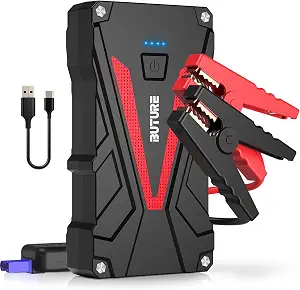 BuTure BR300
|
Mid-Range | 1500A peak with USB-C fast recharge | New drivers wanting compact, safe starter | Check Price | ||
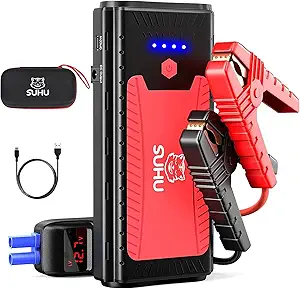 SUHU G27P
|
Budget | Best value capacity and DC port | Graduates on a tight budget wanting good capacity | Check Price | ||
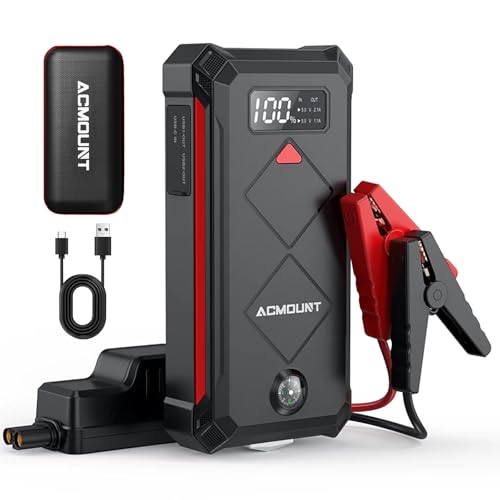 Acmount P100
|
Premium | Very high 5000A peak power | Drivers needing heavy-duty starting power | Check Price |
1. Car Jump Starter, BUTURE 1500A Peak 13800mAh Portable Car Battery Starter (up to 7.0L Gas/5.5L Diesel Engines) Auto Battery Booster Pack with Smart Safety Jumper Cable, Fast Outputs 3.0
The BuTure BR300 is a compact, safety-focused jump starter that blends fast USB-C recharge, smart clamps with multi-protection and a 4-mode LED for roadside visibility. It’s a good balance of portability and features for graduates building a road kit.
Key Specs
- Peak current: 1500A
- Capacity: 13,800mAh
- USB-C input, Quick Charge 3.0 output
- LED modes: Lighting / SOS / Strobe / Warning
Pros
- Smaller and more compact than the Acmount P100
- Faster USB-C recharge time than many budget options
- 2-year warranty gives longer coverage than some premium rivals
Cons
- Lower peak amps and capacity than the Acmount P100
- Less jump capacity per charge than the larger-capacity SUHU model
Best For: New drivers wanting compact, safe starter
Check Latest Price on Amazon2. SUHU Car Jump Starter, 1500A Peak Car Battery Jump Starter (Up to 7.0L Gas and 5.5L Diesel Engine), 12V Jump Starter Battery Pack, Battery Jumper Starter Portable with 3-Mode Light & 5 Charge Ports
The SUHU G27P is the budget pick that still packs practical features: 1500A peak, a larger battery capacity than many mid-range units, multiple USB outputs and a DC port for inflators. It’s geared to drivers who want strong value and basic multi-function utility.
Key Specs
- Peak current: 1500A
- Capacity: ~18,000mAh (manufacturer spec)
- Dual USB outputs including Quick Charge 3.0
- 3-mode LED flashlight; includes protective case
Pros
- Better battery capacity than the BuTure BR300 for similar price tier
- Lower cost and better value per mAh than the Acmount P100
- Includes DC port and protective case — useful for inflators/accessories
Cons
- Build feels less premium and slightly bulkier compared with BuTure
- Some users report concerns about long-term durability compared with higher-end models
Best For: Graduates on a tight budget wanting good capacity
Check Latest Price on Amazon3. P100 Car Jump Starter, 5000A Peak Lithium Jump Starter Battery Pack for Up to 10.0L Gas or 8.0L Diesel Engine, Safe 12V Portable Battery Starter Power Pack with LED Screen & LED Light
The Acmount P100 is a premium, high-power jump starter designed for larger engines and users who want the most reliable starting performance. It offers the highest peak amps, long standby life and integrated safety protections, but is larger and costs more.
Key Specs
- Peak current: 5000A
- Suitable for up to 10.0L gas / 8.0L diesel engines
- Dual USB 3.0 outputs; LED screen and flashlight
- Long standby (can hold charge ~12 months per manufacturer)
Pros
- Far more peak power than BuTure and SUHU — better for heavy vehicles
- Long standby time and robust integrated clamp protections
- Consistently praised for quality and charging capability
Cons
- Larger and heavier than the mid-range BuTure — less pocketable
- Premium price and shorter warranty length than BuTure
Best For: Drivers needing heavy-duty starting power
Check Latest Price on AmazonWhich One Should You Choose?
If budget is tight → Choose the SUHU G27P (B09LH4M9MZ). It gives the best value per capacity, includes a protective case and a DC port for inflators — ideal for a first road kit without overspending. If you need portable → Choose the BuTure BR300 (B07Z1D26CS). It balances compact size, faster USB-C recharge and 2-year warranty, making it excellent for students or grads who store the unit in a backpack or glove box. If premium quality matters → Choose the Acmount P100 (B0B55RFM1Z). Its 5000A peak power and long standby make it the most reliable option for larger vehicles, frequent use, or drivers who prioritize maximum starting power and robust protections.
Best for Specific Scenarios
- College commuter on a budget: SUHU G27P because it delivers larger capacity and more utility (DC port) at a budget price.
- Recent grad who wants something compact: BuTure BR300 because it recharges fast via USB-C, has smart clamps and is easy to store in a glove box.
- Owner of a truck or older car: Acmount P100 because its 5000A peak and high starting reliability cover large engines and tougher starts.
Frequently Asked Questions
Can a portable jump starter replace jumper cables?
Yes — for most drivers a portable jump starter is a safer, one-person alternative to jumper cables because it eliminates the need for a second vehicle and includes built-in protections like reverse-polarity and spark prevention.
How often should I charge a jump starter when not in use?
Manufacturers commonly recommend charging every 2–3 months to keep the internal battery healthy. Premium units with longer standby may hold charge longer, but a regular check ensures readiness.
What peak amp rating do I need for a small car?
Most small to mid-size gasoline cars are reliably started with 1000–1500 peak amps. If you drive a truck, diesel or a large-displacement engine, look for higher peak amps like the 5000A class offered by premium units.
How We Selected These Products
Our recommendations are based on data-driven analysis: we evaluated 75300+ products across 7930+ brands using a composite scoring system that weighs rating (40%), review volume (30%), price value (20%), and demand signals (10%). Every product is ranked by data, not opinions.
Last updated: June 18, 2026
As an Amazon Associate we earn from qualifying purchases at no extra cost to you. Full disclosure.
GarageGist Score is our editorial ranking based on a composite analysis of product quality, value, and verified customer sentiment. Click through to Amazon for current pricing, availability, and live customer reviews.