As an Amazon Associate we earn from qualifying purchases. Learn more.
Best Portable Inverters Under $300 for Rooftop-Tent Fans and Lights (2026)
Planning to run rooftop‑tent fans, LED lighting, and phone chargers without breaking the bank? This guide looks specifically at budget‑friendly pure‑sine and well‑engineered inverters under $300 that do the job at camp. You’ll learn what to expect at each price tier, which units offer the best power‑to‑value, and how to match an inverter to small camping loads. I selected models that balance pure‑sine output, safety protections, proven build features (aluminum shells, cooling), and clear customer feedback about durability and noise.
Quick Answer
For rooftop‑tent fans and LED camp lights on a budget, the DEECHI 2500W inverter (ASIN B0DNJSHN9B) is the best overall pick for 2026 — it balances pure sine output, quiet operation, and long‑range remote control. If value is your priority, the LVYUAN 5000W (ASIN B0CTHGSYCY) delivers the most power per dollar.
Our Top Picks
Quick Comparison
Select 2-3 products to compare side-by-side
| Compare | Product | GarageGist Score | Price Tier | Key Feature | Best For | Action |
|---|---|---|---|---|---|---|
 LVYUAN 5000W
|
Mid-Range | High continuous 5000W output | Campers needing max power/value | Check Price | ||
 DEECHI 2500W
|
Mid-Range | Quiet, pure output with remote | Rooftop tent fans, lights, chargers | Check Price | ||
 Kinverch 750W
|
Budget | Lightweight, cigarette‑lighter use | Minimal loads: fans, phone chargers | Check Price | ||
 VEVOR 5000W
|
Premium | 5000W pure sine with quiet fans | Sensitive electronics & large campers | Check Price | ||
 OUBOTEK 5000W
|
Premium | Pure sine + multiple ports | Off‑grid cabins & heavy RV loads | Check Price | ||
 TVNIKD 1500W
|
Budget | Balanced 1500W for medium loads | Mid-size fans, small fridges, lights | Check Price |
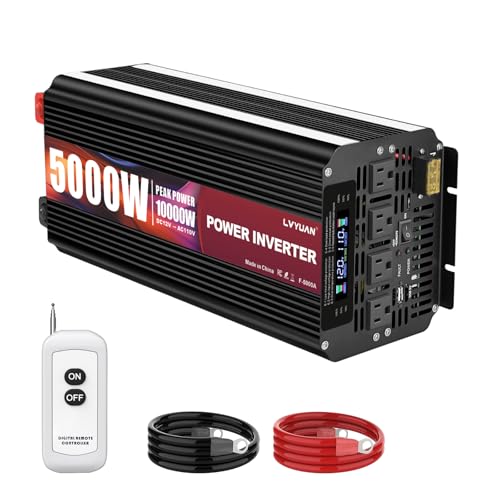
1. LVYUAN 5000 Watt Power Inverter 12V to 110V 120V for Vehicle, Solar Inverter System, Heavy Duty, RV, Truck, Off Grid,Camping with 4 AC Outlets, LCD Display, Wireless Remote Control, Car Power Inverter
LVYUAN packs a huge power envelope for the price, with 5000W continuous (10kW surge), four AC outlets, hardwire terminal and an LCD display. It’s a great value if you want headroom to run higher‑draw devices, though buyers note mixed long‑term durability in some cases.
Key Specs
- 5000W continuous / 10000W peak
- 4 AC outlets + hardwire terminal
- LCD display for voltage/load/battery
- Wireless remote control and intelligent cooling fan
Pros
- Outstanding power-to-price ratio
- Good safety protections (OV/UV/OL/SC)
- Remote control and clear LCD monitoring
Cons
- Mixed reports on long-term durability
- Large and heavier than small portable units
Best For: Campers needing max power/value
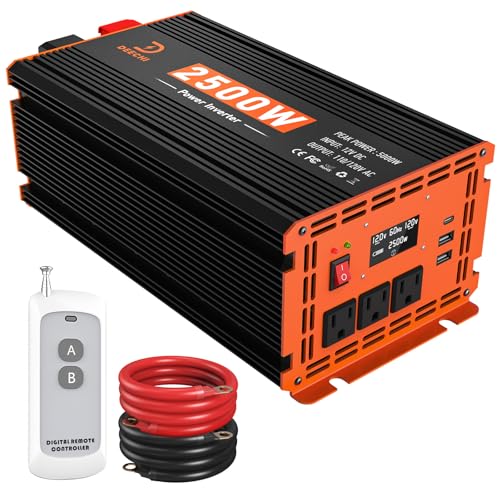
Check Latest Price on Amazon2. 2500W Power Inverter 12V DC to 110V/120V AC Converter for RV/Truck/Boat/Camping/Off-Grid Solar Car Power Inverter Peak Power 5000W with 3 AC Outlets,USB & Type-C Port, Remote Controller & LCD Screen
DEECHI is a balanced pick for campers who want clean, quiet power without premium cost — true 2500W continuous with pure‑sine behavior, an easy‑to-read LCD and a very long‑range remote (up to 200ft reported). Customers praise build quality and quiet fans, making it a reliable daily choice for lights and fans.
Key Specs
- 2500W continuous / 5000W peak
- 3 AC outlets + 2 USB + 1 Type‑C
- Large LCD display and 200ft remote
- Under‑30dB claimed quiet operation
Pros
- True continuous 2500W for sustained loads
- Quiet operation and efficient cooling
- Versatile ports including Type‑C
Cons
- Heavier than smaller budget inverters
- Some users report mixed power delivery in edge cases
Best For: Rooftop tent fans, lights, chargers
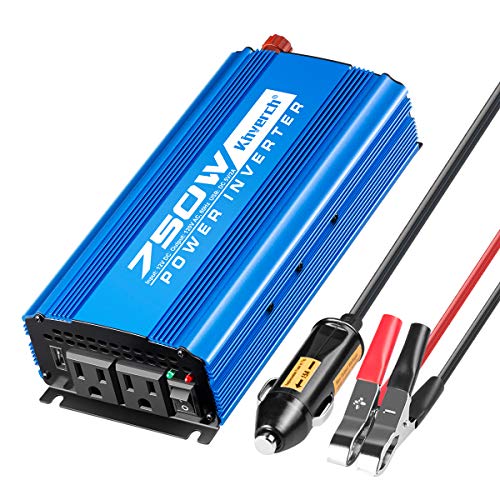
Check Latest Price on Amazon3. 750 Watt Power Inverters DC 12V to 110V AC Converter with 2 AC Outlets and 2A USB Charging Port for Camping Car Power Inverter for Car Cigarette Lighter
Kinverch’s 750W inverter is the budget pick for campers who only need to run small fans, lights, and USB devices. It’s easy to install via cigarette lighter or battery clips and is praised for value and ease of use, though it won’t run heavier appliances and some buyers report inconsistent heat/noise under load.
Key Specs
- 750W continuous / 1500W peak
- 2 AC outlets + 2A USB port
- Connects to cigarette lighter or battery
- 2×40A external fuses and aluminum housing
Pros
- Very affordable and portable
- Simple to install and use
- Good value for small loads
Cons
- Not suitable for larger fans or heaters
- Some reports of overheating or early failure
Best For: Minimal loads: fans, phone chargers
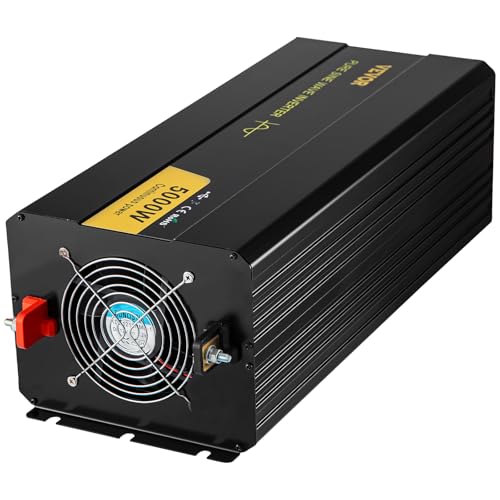
Check Latest Price on Amazon4. VEVOR Pure Sine Wave Inverter, 5000 Watt, Power Inverter, DC 12V to AC 120V Car Inverter, with LCD Display, USB Port and Remote Controller, Power Converter for Car RV Truck Solar System Travel Camping
VEVOR offers a full‑feature pure‑sine 5000W inverter with detailed LCD, remote control and an aluminum shell. Users like the quiet operation and consistent voltage, but there are mixed reports about lifespan — solid choice when you need cleaner power for sensitive gear but weigh longevity concerns.
Key Specs
- 5000W continuous / 10000W surge (pure sine)
- 4 AC outlets + 1 USB port
- LCD + LED indicators and remote control
- Aluminum alloy shell; efficiency ~88%
Pros
- Pure sine output for sensitive devices
- Well built with aluminum housing
- Quiet cooling (20–40dB range reported)
Cons
- Some customers reported premature failures
- Heavier and bulkier to mount on vehicles
Best For: Sensitive electronics & large campers
Check Latest Price on Amazon5. 5000 Watts Power Inverter Peak 10KW, Pure Sine Wave 12V DC to 120V AC Off Grid Solar Inverter with Wireless Remote Control LCD Display 4 AC Outlets Hardwire Terminal for Home RV Camping
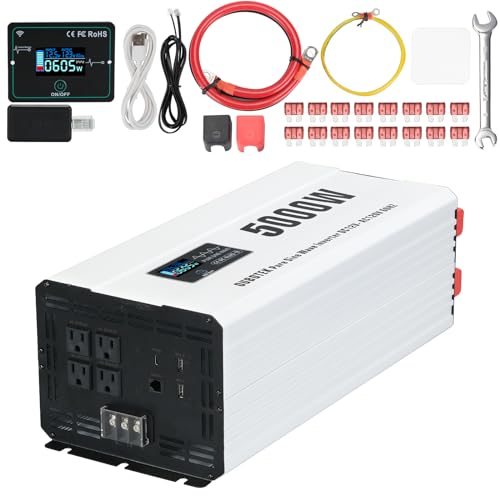
OUBOTEK delivers a feature-rich 5000W pure‑sine inverter with hardwire terminals, USB QC and Type‑C outputs, and a wireless remote. It’s designed for heavier off‑grid use; buyers like the build and low standby draw, though some note noisy fans and occasional voltage drop under extreme loads.
Key Specs
- 5000W continuous / 10000W surge (pure sine)
- 4 AC outlets + hardwire + USB QC3.0 + Type‑C PD30W
- LCD display and wireless/wired remote
- Includes 16×40A fuses and 4AWG cables
Pros
- Comprehensive connectivity for varied loads
- Low standby draw and robust safety gear
- Good build quality for off‑grid setups
Cons
- Fan noise and voltage drop reported under heavy loads
- Setup is more complex due to heavy cabling
Best For: Off‑grid cabins & heavy RV loads
Check Latest Price on Amazon6. 1500 Watt car Power Inverter 12V to 110V/120V for RV car Truck semi Truck Vehicles Camping with LCD Display 1500W
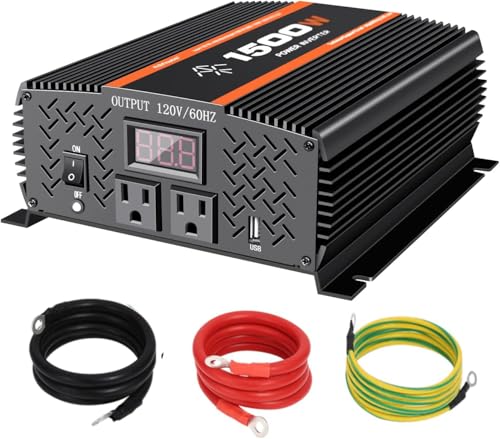
TVNIKD’s 1500W inverter sits between the tiny budget units and large 5k systems — it’s a practical pick for mid‑level camping needs like a fridge plus lights. Customers praise ease of installation and value, though durability reports are mixed and some users experienced failures.
Key Specs
- 1500W continuous / 3000W peak
- 2 AC outlets + dual 2A USB ports
- Updated LCD for battery/load monitoring
- 6×30A built‑in fuses and aluminum alloy casing
Pros
- Good middle-ground power capacity
- Easy to install with included cables
- Affordable for campers who need more than small loads
Cons
- Some durability concerns reported
- Cooling fan can be noisy under load
Best For: Mid-size fans, small fridges, lights
Check Latest Price on AmazonWhich One Should You Choose?
If budget is tight → Kinverch 750W (ASIN B07KJ184NJ). It’s the cheapest way to run a fan, lights and charge phones. If you want the best balance of clean power, quiet operation and ports → DEECHI 2500W (ASIN B0DNJSHN9B) is the safest all‑around pick. If you need maximum power per dollar and want extra surge capacity → LVYUAN 5000W (ASIN B0CTHGSYCY) offers the most raw output for value. If you need pure‑sine for sensitive devices or off‑grid cabins → consider VEVOR 5000W (ASIN B0BLS6W3TX) or OUBOTEK 5000W (ASIN B0CQWDHRKV) for fuller feature sets. For a middle‑ground portable option to run a small fridge and lights → TVNIKD 1500W (ASIN B09KC3VPRR).
Best for Specific Scenarios
- Rooftop‑tent fan + lights only: Kinverch 750W (B07KJ184NJ) because it’s compact, plugs into a lighter, and handles small loads affordably.
- Multiple lights, fans and phone/tablet charging: DEECHI 2500W (B0DNJSHN9B) because it provides true continuous power, quiet cooling and extra USB/Type‑C ports.
- Off‑grid weekend with heavier appliances: LVYUAN 5000W (B0CTHGSYCY) or OUBOTEK 5000W (B0CQWDHRKV) because they deliver high continuous and surge power and hardwire options for vehicle or solar systems.
Frequently Asked Questions
Do I need a pure sine inverter for ceiling/rooftop tent fans?
Yes — pure sine is recommended. Fans and LED drivers run smoother and quieter on pure sine; modified sine can cause motor noise, reduced efficiency or shorten motor life. If you only power simple incandescent bulbs and phone chargers, modified sine may be acceptable, but pure sine is safer for long term use.
How do I size an inverter for my rooftop‑tent setup?
Add the continuous wattage of every device you plan to run simultaneously (fans, lights, chargers) and choose an inverter with at least 20–30% headroom. Account for surge needs: motors can draw 2–3× their running wattage at startup, so pick an inverter with a surge rating that covers those spikes.
Are heavy gauge cables and hardwiring necessary?
Yes for larger inverters. Small cigarette‑lighter models can work for low draws, but anything above ~500–750W should use heavy gauge (AWG) battery cables and proper fusing/hardwire connections to avoid voltage drop, heat and potential fire hazards. Many mid and premium models include appropriate cables or terminals.
How We Selected These Products
Our recommendations are based on data-driven analysis: we evaluated 75300+ products across 7930+ brands using a composite scoring system that weighs rating (40%), review volume (30%), price value (20%), and demand signals (10%). Every product is ranked by data, not opinions.
Last updated: July 14, 2026
As an Amazon Associate we earn from qualifying purchases at no extra cost to you. Full disclosure.
GarageGist Score is our editorial ranking based on a composite analysis of product quality, value, and verified customer sentiment. Click through to Amazon for current pricing, availability, and live customer reviews.